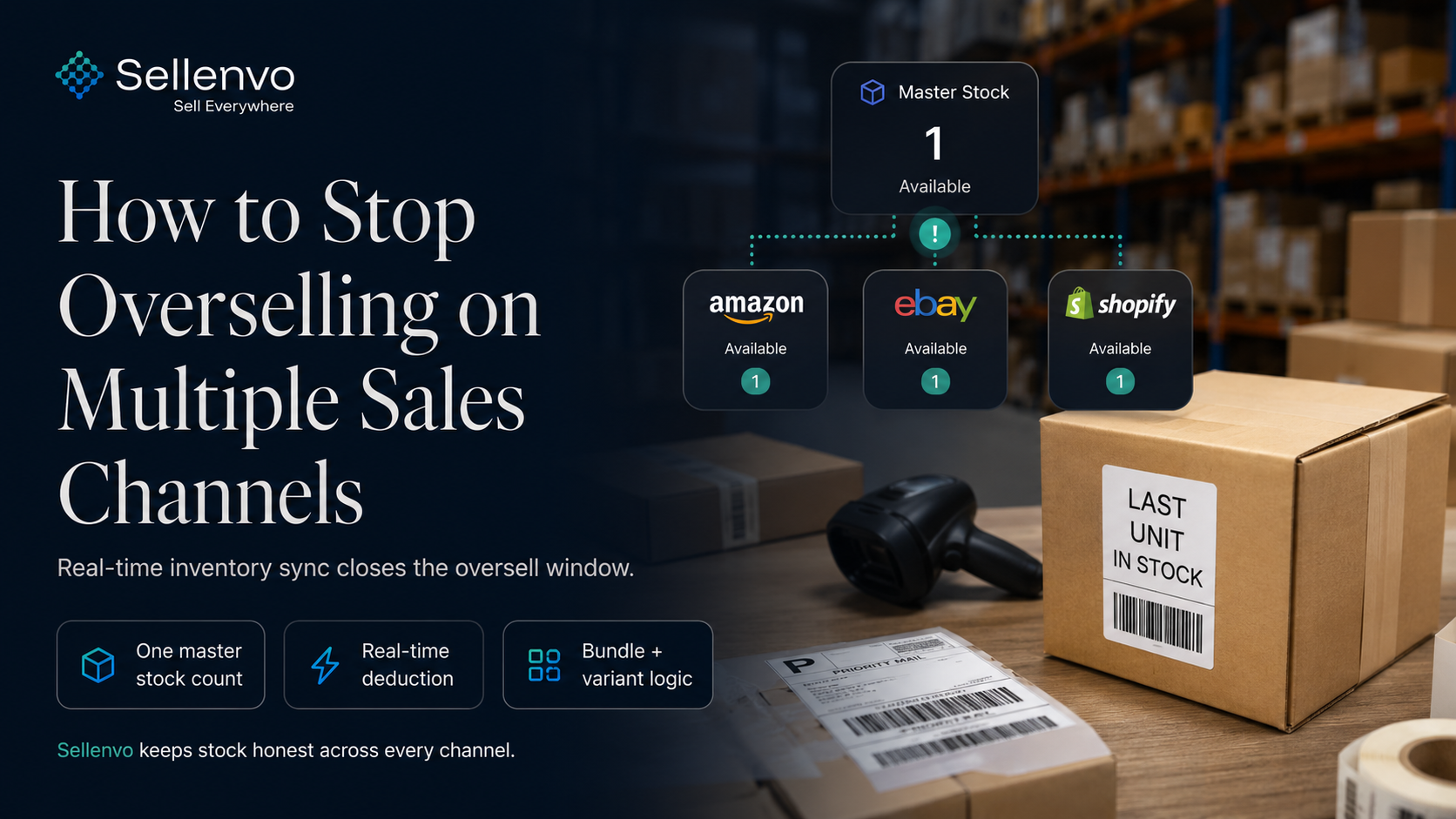
Overselling is the quiet killer of multi-channel stores. You sell the same unit twice because two channels both showed it in stock, then you cancel an order, refund a frustrated buyer, and take a hit to your seller metrics. The cause is almost always the same: your channels track stock as separate numbers instead of one shared number. Fix that, and overselling stops. Here is how.
The short version: overselling happens in the gap between a sale on one channel and the stock update on the others. Close that gap with real-time inventory sync and the problem disappears.
Why overselling actually happens
It is rarely carelessness. It is timing. Say you have one unit left and it is listed on Amazon, eBay, and Shopify. A customer buys it on Amazon. Until every other channel knows that unit is gone, it is still for sale on eBay and Shopify. On a slow day that window is harmless. During a promotion or a seasonal spike, that is exactly when a second customer buys the unit you no longer have.
Manual updates and scheduled syncs (say, every few hours) leave that window open. The only real fix is for a sale on any channel to deduct stock everywhere within seconds.
The four-step fix
1. Create one master stock number per SKU. Every channel reads from the same figure, rather than each holding its own count you try to keep matched. 2. Turn on real-time deduction. When an order lands on any channel, available stock drops everywhere immediately, not on the next scheduled pull. 3. Handle bundles and variants correctly. If a bundle shares components with other listings, selling the bundle must decrement every affected SKU. Manual systems miss this and drift. 4. Set low-stock buffers. For your fastest movers, hold a small safety buffer so a sync delay never tips you into oversold.
How to set this up
Connect your channels to a multi-channel platform and enable real-time sync so one stock number drives every listing. With Sellenvo's inventory syncing, a sale on any channel updates the others within seconds, and bundle and variant logic is handled for you. You list once across channels with multi-channel listing and the stock stays honest from then on.
Manual sync vs real-time sync
| Manual or scheduled sync | Real-time sync | |
|---|---|---|
| Update speed | Hours, or by hand | Seconds |
| Oversell window | Open | Effectively closed |
| Bundle logic | Easy to miss | Handled |
| Risk during promos | Highest | Controlled |
| Effort | Constant | Set once |
What overselling really costs
It is not just the refund. On Amazon, cancellations driven by stock errors hurt your order defect rate, which affects your Buy Box eligibility and visibility. So one oversell can quietly cost you future sales, not just the one you canceled. That is why closing the gap is worth doing properly rather than patching by hand.
Bringing it together
Overselling is a timing gap, not a discipline failure. One master stock number, real-time deduction across channels, correct bundle logic, and a small buffer on fast movers. Put those in place and the cancellations stop.
Sellenvo keeps stock accurate across every channel in real time, on a pay as you grow plan with a free trial and an increase-sales-or-money-back guarantee. Start a free trial or book a demo.
Frequently asked questions
How do I stop overselling across channels?
Use one master stock number per SKU and enable real-time inventory sync, so a sale on any channel deducts stock everywhere within seconds. That closes the gap where overselling happens.
Why does overselling keep happening even though I update stock?
Because manual or scheduled updates leave a window between a sale and the update reaching other channels. During busy periods, a second customer buys in that window. Real-time sync removes it.
Does overselling hurt my Amazon account?
Yes. Stock-driven cancellations raise your order defect rate, which can affect Buy Box eligibility and visibility, so the cost goes beyond the single refund.
How do bundles cause overselling?
If a bundle shares stock with individual listings, selling the bundle has to reduce every component SKU. Systems that do not calculate this drift into oversold positions.
Do I need a buffer if sync is real-time?
A small buffer on your fastest-selling items is sensible insurance against any momentary delay, but with real-time sync it is a safety margin, not a crutch.